
The Best Journaling App for ADHD Brains: Why Streaks Fail and What Actually Works
Table of Contents
If you've ever downloaded a journaling app, you've probably also quit one, usually in the same quiet, slightly defeated way. The pattern tends to look something like this: the app feels promising for a week or so, then a day gets away from you and the streak resets, something tightens in your chest, the icon drifts onto page three of your home screen, and a week later it's gone.
If any of that sounds familiar, the problem isn't your willpower. It's that most journaling apps were built around a kind of motivation that doesn't quite match how a lot of ADHD adults actually live. This guide is about why those apps keep failing you, and what a journaling tool that fits the way your mind actually works might look like instead.
Key Takeaways
- A lot of ADHD adults quit journaling apps, and streak guilt is usually somewhere in the story
- Curiosity about yourself tends to last longer than streaks, points, or completion bars
- Apps that lower the friction to start, allow irregular use, and surface patterns tend to stick
Why you keep quitting
ADHD diagnoses in adults have climbed sharply over the last decade, and yet most journaling apps still quietly assume that everyone responds to streaks, daily reminders, and tidy little reward bars in the same way. They don't, and that mismatch is doing more damage than the design teams seem to realise.
A lot of ADHD adults recognise this even before they have a name for it: small failures tend to land disproportionately hard. Missing one day doesn't feel like missing one day; it feels like proof that you're broken in some fundamental way. There's a clinical term for that pattern, rejection sensitive dysphoria (or RSD), coined by ADHD specialist William Dodson; it isn't a formal diagnosis yet, and the research is still early, but it describes something most people recognise the moment they hear it.
If that's you, then a streak counter dropping from 12 to 0 isn't a neutral piece of UI. It's a small, repeated punch, and the cycle that follows tends to play out the same way every time:
- You miss a day.
- The streak resets, visibly.
- The "I failed" signal spikes.
- You decide you need to start over perfectly or not at all.
- Stopping wins, because stopping is what makes the feeling go away.
None of that is a character flaw. It's a normal, almost predictable response to a design that simply wasn't built with your nervous system in mind.
For a deeper look at RSD specifically, see Rejection Sensitive Dysphoria and Journaling: Breaking the Shame Cycle. The full five-stage abandonment cycle is mapped out in Why ADHD Brains Abandon Journaling Apps: Understanding Shame Spirals.
The problem with streaks
Habit apps run on a simple loop (do the thing, get a point, feel good, do it again tomorrow), and for a lot of ADHD adults that loop doesn't just fail to work; it actively runs in reverse. Brain imaging research (Volkow et al., 2009) has found measurable differences in how dopamine functions in the reward circuits of ADHD brains, which in plain terms means the small "you did it" hit of earning a point often doesn't register as much of a reward at all. Losing the streak, on the other hand, still stings exactly as much as it was designed to. So what looks on paper like a gentle nudge becomes, in practice, a small, repeated discouragement that accumulates quietly each time the counter resets.
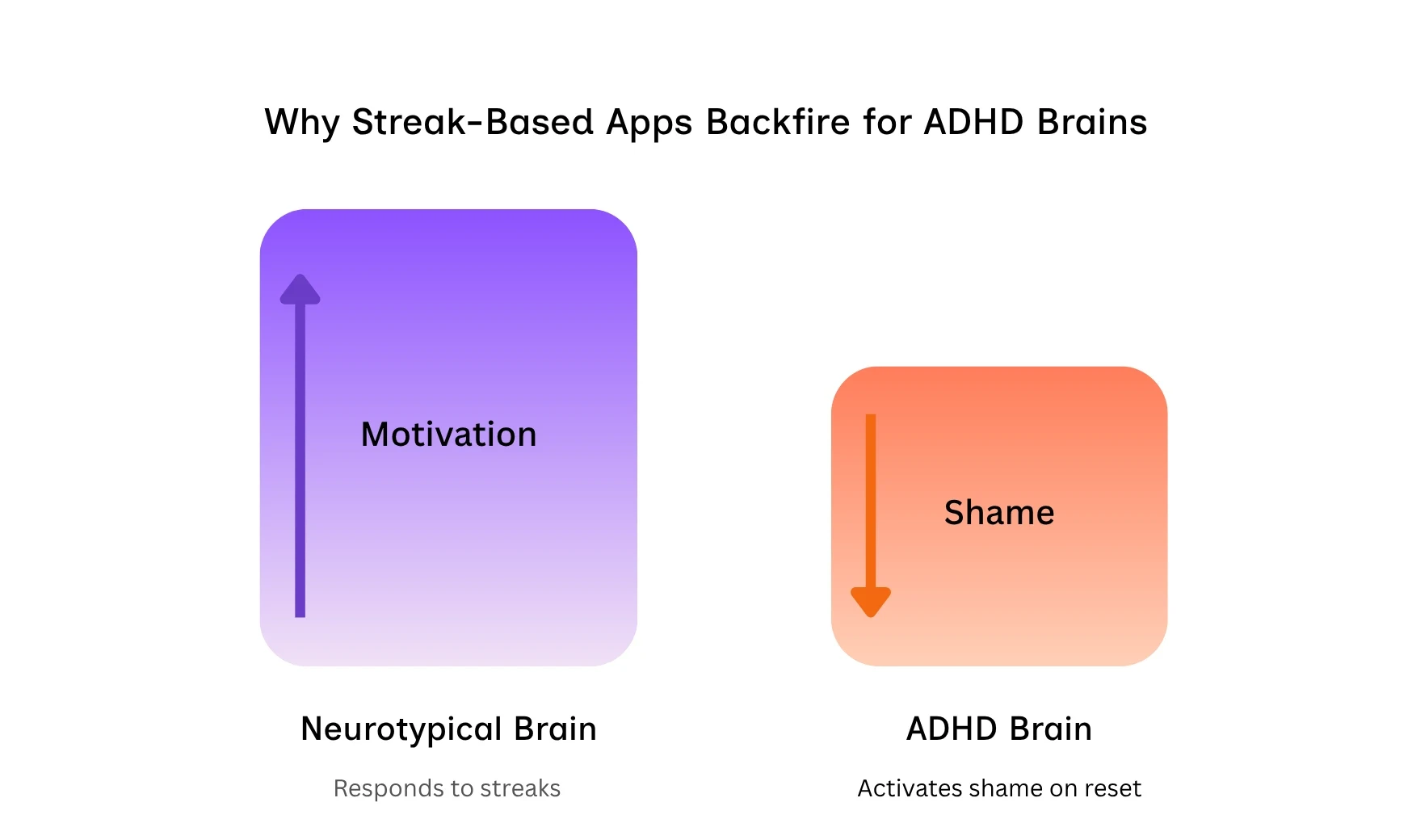
There's a second problem sitting underneath the first: starting things is genuinely hard. Task initiation is one of the most consistently impaired executive functions in ADHD, which means that opening the journal can take half an hour of internal negotiation even though writing the entry itself takes about ninety seconds. To a lot of neurotypical people those two moments feel like the same act. For you, they really don't.
Daily streaks ask you to clear that "just open it" hurdle every single morning, and the moment you miss once, a new feeling stacks on top of the old one: the dread of starting over. By the third restart, the dread tends to weigh more than the task it's wrapped around, and the app stays closed.
"Just do it every day" doesn't work
"Five minutes a day" is the universal advice, and for a lot of ADHD adults it tends to fall apart almost immediately. Not because the advice is bad, but because it quietly assumes a relationship with time that doesn't reliably exist. Research on time perception in ADHD has consistently found measurable differences in how minutes register internally: five minutes can feel like forty-five seconds right up until the moment you look up and realise two hours have vanished. Russell Barkley calls this pattern time blindness, and it's the kind of phrase that tends to land with a quiet nod of recognition.

In practice, it shows up in a handful of overlapping ways:
- You can't feel time passing the way other people seem to.
- "Do it daily" assumes an internal alarm clock you don't actually have.
- Switching between things costs more energy than the things themselves.
The kind of consistency that habit apps quietly demand assumes a steadiness most ADHD adults simply don't experience, and the gap between the two isn't a sign that you're failing on purpose. You run on novelty, hyperfocus, and intensity rather than smooth daily repetition, which means a journaling tool that actually fits your life has to let you capture moments as they land rather than when the clock says so, and it has to accept, without sulking about it, that your rhythm will be uneven.
For practical strategies, including the "whenever" capture model, see Time Blindness and Journaling: Why Consistency Doesn't Work for ADHD Brains.
What ADHD-friendly journaling actually looks like
If streaks fail, daily pressure fails, and open-ended forms fail, what's actually left? Roughly three things, working together: low activation energy, autonomy without guilt, and pattern feedback.
Low activation energy means every decision has already been pre-made for you. Instead of facing a "write about your day" prompt, you tap once to pick a mood, tap once for a life area, tap once to mark how significant the moment felt, and optionally tap once more for a highlight. No blank page, no cursor to stare down, the whole thing finished in roughly thirty seconds. The structure isn't a limitation here; it's the thing that lets you start at all.
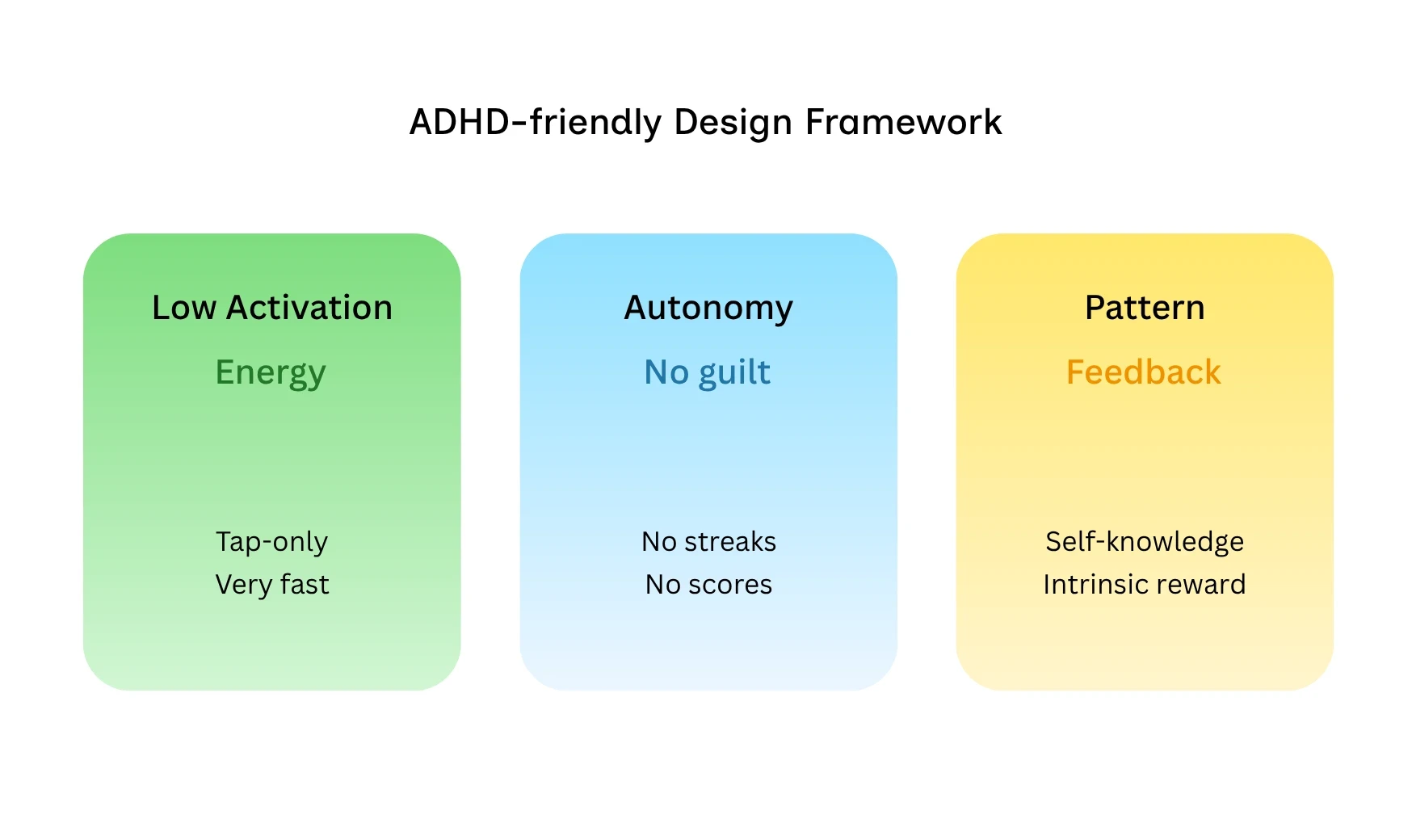
Autonomy without guilt means no mandatory frequency, no streaks, and no completion percentage quietly staring you down from a corner of the screen. Miss a week and you come back whenever; miss a month and there's still no shame layered onto your return. That message has to be carried in the design itself rather than buried in an FAQ. Your reflection belongs to you, on your own timeline, and once that's clear, the RSD trigger disappears with it. You aren't failing; you're living an irregular life, which is what every life looks like up close.
Pattern feedback replaces external rewards with intrinsic ones. Rather than "you journaled five times this week," the app surfaces things like you feel best after movement, this person consistently energises you, your energy dips on Sundays. These observations activate curiosity and self-knowledge, two motivators that scale far better than streak counters across irregular use.
Wonaby is built on that trio: a tap-only thirty-second capture, no streaks, and pattern recognition that surfaces insights from what you've actually logged rather than from an AI's guess about what you must be feeling.
Pattern recognition: the motivation that actually lasts
The motivators that tend to keep ADHD adults engaged with anything (autonomy, mastery, curiosity) are internal, not external. Self-determination theory (Deci & Ryan) calls these intrinsic motivators, and there's good reason to believe they hold up better than points and streaks for ADHD users specifically. Pattern recognition touches all three at once.

This matters most when your usage is uneven, which realistically will be. Streak-based designs collapse the moment your rhythm breaks, while pattern-based designs barely notice; gaps in your data are simply gaps, and the patterns continue to come through around them.
A note on the science: Self-determination theory has decades of evidence behind it as a general framework for sustained motivation. But the specific claim that pattern-based journaling apps outperform streak-based ones for ADHD users hasn't been tested in controlled studies, those studies mostly don't exist yet. What we have is clinical experience, motivation research, and what ADHD adults tell us about what they actually keep using. We've built around that.
For the head-to-head breakdown, see Pattern Recognition vs Streaks: Why ADHD Brains Need Data, Not Gamification.
How to choose an ADHD-friendly journaling app
If you're sizing up a journaling app for yourself, a few quick filters tend to save a lot of disappointment further down the line.
Red flags in other apps:
- "Just be consistent" messaging anywhere in the marketing
- Streaks, completion percentages, or any "unbroken chain" mechanic
- Mandatory daily entries or guilt-tripping notifications
- A blank page as the main input
- Cloud AI that reads your entries and summarises them back at you
Green flags to look for:
- You can capture something in under a minute
- Missing days is genuinely fine
- Structured taps instead of empty text fields
- Pattern insights, not performance metrics
- On-device processing or end-to-end encryption
- Copy that explicitly says "come back whenever"
One last consideration worth flagging: privacy. If you don't trust where your reflections are going, you won't write what's actually true, and a journal that isn't true is worse than no journal at all, because it slowly teaches your nervous system that this isn't a safe place to be honest.
How Wonaby puts this into practice
Wonaby translates the three pillars into a handful of concrete design choices, anchored to ADHD research rather than to a feature list.
Thirty-second taps. There's no blank page, no cursor blinking at you, no "where do I even start?" spiral to navigate before you've begun.
No streaks, no completion percentages, no missed-day notifications. There is nothing in the design that punishes you for being a human with an uneven life.
Capture the moment, not the calendar. You log when something actually matters, rather than when an arbitrary daily reminder says it's time to.
Pattern feedback from your own data. Wonaby surfaces the patterns and you read them, with the AI handling the wording rather than the conclusions.
Private by default. On-device AI and end-to-end encryption mean your thoughts never leave your phone.
As with the science note above, these are design choices grounded in clinical experience and motivation research rather than in controlled trials, and we try to be honest about which is which.
Building a rhythm that actually works
If "every day at 9am" has never really been your operating system, the rhythm below tends to fit ADHD brains a lot more comfortably.
1. Capture whenever it lands. A conversation, a mood shift, a small realisation: whatever it is, stop and log it in thirty seconds. The moment matters because it's fresh, not because it was scheduled.
2. Use voice when text feels hard. Some days writing flows easily and some days talking is the lower-friction option; use whichever costs you less in the moment.
3. Read patterns, not entries. Scrolling through everything you've ever written is a fast route to overwhelm, so let the app spot the repetitions and spend your attention on those instead.
4. Expect uneven weeks. Some weeks you'll log ten things a day and other weeks nothing at all. That uneven rhythm is your actual shape, and it's worth giving up the fight against it.
5. Come back without an apology. When you return after a break of any length, skip the guilt spiral entirely; just open the app, tap a moment, close it again.
The point was never calendar consistency. It's self-knowledge that quietly builds up in the background over months and years.
For step-by-step techniques you can use today, see How to Journal with ADHD: Practical Tips for Executive Dysfunction.
The worries that come up
A few worries come up almost every time someone with ADHD considers a new journaling approach. They're worth addressing directly, because most of them are the old streak-thinking trying to sneak back in through the side door.
"I'll forget the app exists." You probably will, for stretches at a time, and that's genuinely fine. Pattern-based journaling doesn't punish gaps, and the patterns themselves stay useful even with irregular data feeding them.
"If there's no streak, I won't be motivated." That worry usually comes from people who've quietly mistaken guilt for motivation, and guilt always collapses the moment a streak breaks while curiosity about yourself doesn't. That said, if streaks genuinely help you, Wonaby lets you turn them on; they're off by default, but the choice is yours.
"What if no patterns emerge?" They will, given enough time. Patterns need some data to surface against, but for most people the obvious ones start showing up within a few weeks, and the subtler stuff appears over months.
"What if my entries are too short to mean anything?" Short is genuinely the goal here. The mood, the life area, and the significance rating do most of the heavy lifting on their own; long entries aren't better than short ones, and frequent short captures almost always outperform occasional long ones.
"I've quit so many apps. Why would this be different?" Because the reason you quit before probably wasn't you, it was the design. Take away the streak, the daily pressure, and the blank page, and the thing that pushed you out the door is no longer there to push.
FAQ
Can journaling actually help with ADHD?
There's solid research that reflective writing helps mood and self-understanding in general (Pennebaker's expressive writing studies are the foundation), and self-compassion practices help with self-criticism (Kristin Neff's work). ADHD-specific journaling research is thin, but clinically, low-pressure reflection tends to support self-knowledge. The trick is keeping the pressure low.
Why do I keep quitting journaling apps?
Shame-inducing design, the cost of starting things, and unreliable time perception, usually all three at once.
Is voice journaling better for ADHD than writing?
It depends on the day, and the most honest answer is to use whichever one you'll actually do right now.
What's the difference between journaling and mood tracking?
Mood tracking is a number; journaling is the story around the number, and the patterns are what quietly link the two together.
Do I need an app, or can I just use Notes?
If you'll genuinely open it, then yes, but most people don't, because the blank page kills it, and structured apps exist mainly to reduce that specific friction.
Can journaling replace therapy or medication?
No, it's a complement rather than a substitute. Therapy and medication (where appropriate) do the heavy lifting, and journaling is the layer that helps the rest of it land.
How long until the patterns are useful?
It varies, but most people start noticing things within a few weeks of irregular use, and the deeper stuff tends to build steadily over months.
The bottom line
Most journaling apps were built around a kind of motivation you simply don't have, and that mismatch is not your fault. When the tool actually fits the way your mind works, journaling stops being something you have to maintain and becomes something you come back to because you're genuinely curious about what it'll show you about yourself.
That's the difference between an app you'll quit and a practice that quietly changes how you understand your own life.
Related Reading
- How to Journal with ADHD: Practical Tips for Executive Dysfunction — seven techniques for executive dysfunction
- Why ADHD Brains Abandon Journaling Apps: Understanding Shame Spirals — The behavioral cycle of abandonment
- Rejection Sensitive Dysphoria and Journaling: Breaking the Shame Cycle — The neurological root of shame activation
- Time Blindness and Journaling: Why 'Daily' Doesn't Work for ADHD Brains — Temporal perception barriers explained
- Pattern Recognition vs Streaks: Why ADHD Brains Need Data, Not Gamification — The motivation redesign that works
Sources
- CDC, Adult ADHD Diagnosis and Prevalence, MMWR (2024, Retrieved May 2026)
- Volkow, N. D., et al., Motivation Deficit in ADHD and the Dopamine Reward Pathway, Molecular Psychiatry (2009, Retrieved May 2026)
- Ptacek, R., et al., Clinical Implications of the Perception of Time in ADHD: A Review, PMC (2019, Retrieved May 2026)
- Rowney-Smith, et al., The Lived Experience of Rejection Sensitivity in ADHD: A Qualitative Exploration, PMC (2026, Retrieved May 2026)
This article is published by Wonaby. All statistics are sourced from peer-reviewed research and public health databases. Journaling is a complement to, not a replacement for, professional mental health treatment.