Why ADHD Brains Abandon Journaling Apps: Understanding Shame Spirals
Table of Contents
You quit 8 journaling apps. Each time you told yourself you'd try again. Each time you didn't.
The problem is the app design, which works against a lot of ADHD brains. Streak counters, daily reminders, and guilt-based messaging are built around neurotypical motivation. For many ADHD brains, they tend to trigger shame rather than reward.
Understanding why you quit isn't about self-blame. It's about recognizing a predictable pattern. And once you see the pattern, you can break it.
Key Takeaways
- ADHD brains abandon journaling apps more readily than neurotypical users, often within the first couple of weeks
- Blank-page writing tends to stall ADHD users early; the bigger problem is the shame-based design that follows a missed day
- Streak counters and daily-expectation messaging tend to land on the brain's emotion-processing regions, which research links to differences in ADHD
- Task avoidance in ADHD is often emotion regulation, not laziness; you quit the app to escape shame, not because you don't want to journal
- Removing streaks, daily expectations, and guilt-based messaging makes people far more likely to keep using a journaling app
What Is a Shame Spiral?
A shame spiral is a self-reinforcing cycle: a missed session triggers shame, shame drives avoidance, avoidance leads to deleting the app, and then you feel shame about deleting it too. For a lot of ADHD brains this cycle is predictable, because streak counters and daily reminders tap into the same emotional response that makes failure feel catastrophic rather than merely disappointing. The app stops being a journaling tool and becomes a source of dread. (This pattern is a big part of why mental-health apps see such high early dropout; see App Abandonment in Digital Mental Health, PMC, 2024.)
The distinction that matters is shame vs. guilt. Guilt says "I did something bad" and can push you to try harder. Shame says "I am bad" and tells you to escape. Many ADHD brains land on shame rather than guilt, which is why a broken streak doesn't prompt a fresh attempt; it prompts avoidance. The play-by-play of how that unfolds over a couple of weeks is the five-stage timeline later in this post.
Shame Spirals vs RSD: Understanding the Connection
Two things are easy to conflate here, so it's worth separating them. RSD (rejection sensitive dysphoria) is the underlying sensitivity: a trait where the brain processes perceived failure with amplified emotional intensity. The shame spiral is the behavioral cycle that plays out when app design keeps poking that sensitivity, notification by notification.
That's why the same broken streak that's mildly frustrating for most people can feel catastrophic with RSD in the mix. RSD isn't a formal diagnosis, but ADHD specialist William Dodson, who named it, estimates it affects a large share of people with ADHD. Naming both layers is what explains why removing shame triggers (the app design) works better than willpower or motivation advice: those address neither layer. For the deep dive into RSD itself, see Rejection Sensitive Dysphoria and Journaling: Breaking the Shame Cycle.
How Journaling App Design Triggers Shame
Three design features tend to turn journaling apps into shame machines for ADHD brains: streak counters that make missed sessions visible and quantified, daily-expectation messaging that lands as accusation rather than encouragement, and guilt-based retention copy that implies ongoing failure. None of them are incidental; they're a primary reason people abandon these apps early, and apps that drop them tend to keep ADHD users far longer. (Time blindness makes those daily expectations especially hard to meet in the first place.)
1. Streak Counters
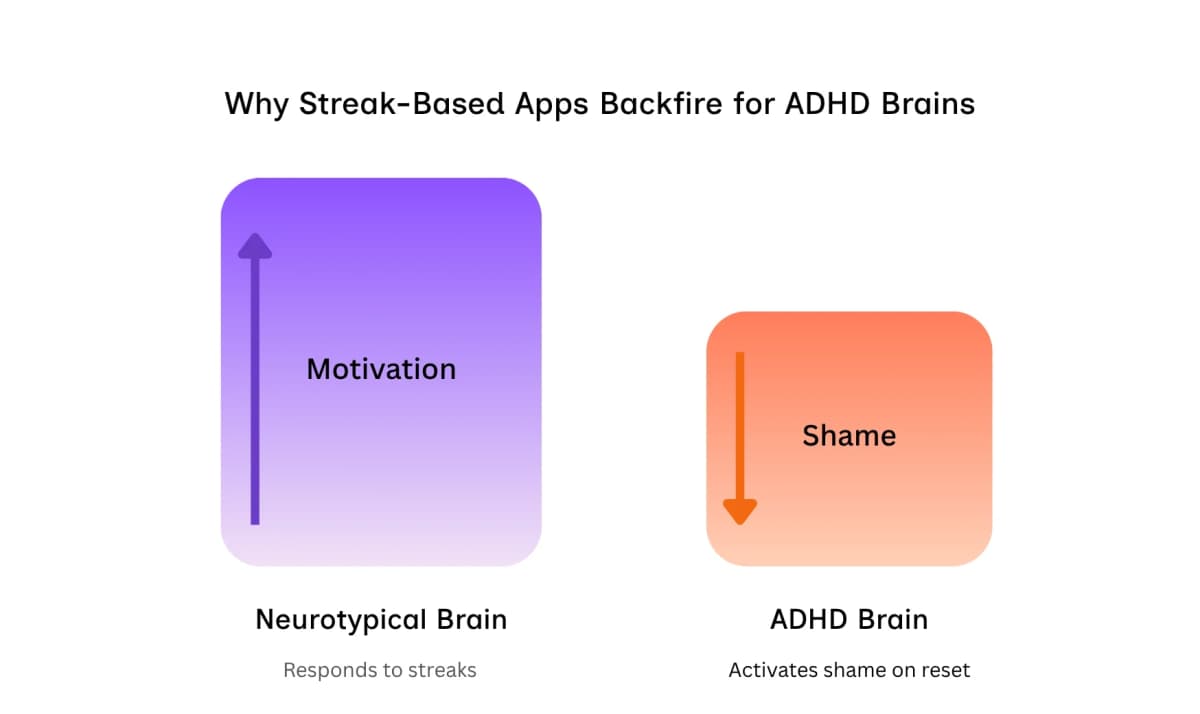
A 3-day streak feels like proof of success. But when you miss day 4, it becomes proof of failure. Broken streaks feel like a public/private failure. Your ADHD brain with compromised dopamine regulation doesn't experience the streak as "motivation to continue." It experiences the break as "I'm unreliable. I failed. I'm bad at this."
Neurotypical brains tend to find broken streaks mildly frustrating. Many ADHD brains find them shame-activating. That's a big reason apps without streaks tend to hold ADHD users for longer.
2. Daily-Expectation Messaging
"Don't break your streak." "Journal today." "You haven't journaled yet."
These messages are meant to remind. But for many ADHD brains, reminders engage the regions that process threat and negative emotion, such as the amygdala and anterior insula (Anterior Insula Hyperactivation in ADHD, PMC, 2024). The message lands as an accusation, not a reminder.
3. Guilt-Based Retention Copy
"Start your journey today." "Build consistency." "Don't lose your progress."
These are motivational framings for neurotypical brains. For ADHD brains, especially those with emotional dysregulation, they're triggers. They imply you've already failed and activate the very emotion you're trying to avoid.

The ADHD Brain's Shame Sensitivity
Many ADHD brains seem to feel shame more intensely than neurotypical brains, and brain-imaging research points to two relevant differences. The first: amygdala volume is associated with ADHD severity, independent of anxiety or depression, which correlates with greater reactivity to emotional threat rather than less emotion processing (Amygdala Volume and ADHD Severity, PMC, 2024). The second: when ADHD brains meet negative stimuli, like a broken-streak notification, the anterior insula (a region tied to how strongly we feel negative experiences) tends to be more active (Anterior Insula Hyperactivation in ADHD, PMC, 2024). These aren't character traits; they're differences researchers can measure, and they help explain why a broken streak can feel catastrophic rather than merely inconvenient.
Put together, that's the chain: missed session → notification → amygdala and insula hyperactivation → shame → task avoidance.
This points to something important: task avoidance in ADHD is often emotion regulation, not laziness. When you quit the journaling app, you're not failing at journaling. You're protecting yourself from the shame feeling by removing the trigger.
That's why "try harder" advice falls flat. You're not avoiding because you lack willpower, but because the feeling has become unbearable.
The 5 Stages of App Abandonment
The shame spiral tends to follow the same five-stage timeline across apps: enthusiasm, then friction, then guilt, then avoidance, then deletion. When RSD meets streak-based design, each stage is predictable. It isn't a personal failure, it's what tends to happen when ADHD neurology runs into shame mechanics. Recognizing the stages helps you see when you're in the cycle and why, rather than reading it as evidence you "can't stick with anything." For how pattern recognition breaks this cycle by replacing shame triggers with curiosity, that post explains the design alternative.
Stage 1: Enthusiasm (Day 1-2) New app, fresh start, dopamine boost. Your ADHD brain loves novelty. Everything feels possible.
Stage 2: Friction (Day 3-5) First missed session. Or decision fatigue (what should I write today?). The novelty wears off. Activation energy rises.
Stage 3: Guilt Activation (Day 5-7) The streak counter shows the break. Notifications start. Your brain interprets this as failure. Shame activates. You start avoiding the app.
Stage 4: Avoidance (Day 8-14) Opening the app now triggers the shame feeling. Avoidance deepens. You stop opening it. The notifications pile up, making it worse.
Stage 5: Deletion (Day 14+) The app reminder becomes unbearable. You delete it to escape the shame. Then you feel shame about quitting. The cycle repeats with the next app.
With most current app designs, each stage tends to follow the last. The shame spiral isn't a personal failure. It's a predictable outcome of ADHD neurology meeting streak-based design.
Why "Just Try Again" Doesn't Work
"Just try again" assumes the problem is motivation, when the real problem is emotion regulation. Adding more motivation (a new app, a fresh streak, encouraging messages) doesn't fix the shame response; it just creates more chances to feel like you're failing. And once an app is tied to that feeling, people rarely come back to it, because the emotional association has already formed.
So "I'll try a different app and be consistent this time" misreads what went wrong. The design was the trigger, not your willpower, and a fresh app with the same streak mechanics just builds a new shame association on the same foundation. The only thing that reliably breaks the cycle is removing the shame triggers, not adding motivation.
Breaking the Shame Spiral
Breaking the shame spiral isn't about lowering your standards. It's about removing the three design features that make avoidance the only rational response to emotional pain, and replacing them with neutral feedback, flexible frequency, and pattern-based insights. For practical techniques that put this to work from day one, see How to Journal with ADHD: Practical Tips for Executive Dysfunction.
1. No Streaks
Remove the metric that measures failure. Without streaks, a missed session is just a missed session. No judgment. No proof of unreliability.
2. No Daily Expectations
Replace "journal today" with "capture whenever." Replace daily reminders with event-based prompts. Let the user decide when to engage, not the app.
3. Neutral Tone
Replace guilt-based copy with factual feedback. Instead of "Don't break your streak," say "You last captured 3 days ago." Same data. Zero shame activation.
These changes don't just feel better. They remove the thing that pushes ADHD users out the door, which is why apps without shame-activation features tend to keep people for much longer.
This is how Wonaby approaches journaling. No streaks. No daily guilt. No shame spirals. Just capture, whenever you're ready, however you want.
FAQ
Is it just ADHD, or do other people struggle with journaling apps too?
Everyone struggles with app abandonment to some degree (App Abandonment Research, PMC, 2024). But ADHD users tend to struggle more, because amygdala reactivity and emotion dysregulation raise the stakes. Other populations often quit for motivation reasons. For many ADHD users it's emotion regulation.
Why do I feel ashamed after quitting, not relieved?
Because shame activates two contradictory responses: approach (fix this) and avoidance (escape). Relief would come if the solution felt possible. But with each failed app, the solution feels more distant. The shame compounds.
If I know this is a shame spiral, why can't I just stop it?
Because it's neurological, not logical. Knowing the pattern doesn't rewire the amygdala. Knowing it helps, it removes self-blame. But breaking it requires changing the external trigger (the app design), not the internal narrative (telling yourself you're good enough).
Is there an app that doesn't use streaks or guilt-based design?
Most journaling apps use streaks because streaks drive engagement metrics. Wonaby and a few others use design specifically built for ADHD: no streaks, no daily expectations, voice + text capture, immediate access without friction.
Can I go back to a journaling app I quit before?
You can try. But the shame association is already formed. Your brain now connects that app with failure. Starting with a different app, one without streaks, resets the emotional association. You're not starting over with the same shame trigger.
Conclusion
The shame spiral isn't a character flaw. It's neurological. ADHD brains + shame-based app design = a predictable failure cycle.
A reframe worth holding onto: each time you quit a journaling app, you're not failing. You're recognizing what doesn't work for you. That's data. Your brain is protecting you from an unsustainable shame cycle.
The next app you try, look for:
- No streaks
- No daily reminders
- Voice + text options
- Judgment-free capture
Your ADHD brain isn't broken. It just needs design built for how it actually processes emotion.
Related Reading
- The Best Journaling App for ADHD Brains: Why Streaks Fail and What Actually Works — the complete ADHD journaling framework
- Rejection Sensitive Dysphoria and Journaling: Breaking the Shame Cycle — the neurological root of shame activation
- How to Journal with ADHD: Practical Tips for Executive Dysfunction — techniques that work around shame triggers
- Time Blindness and Journaling: Why 'Daily' Doesn't Work for ADHD Brains — why daily expectations compound shame
- Pattern Recognition vs Streaks: Why ADHD Brains Need Data, Not Gamification — the motivation redesign that breaks the cycle
Sources
- App Abandonment in Digital Mental Health, PMC (2024, Retrieved May 2026)
- Amygdala Volume and ADHD Severity, PMC (2024, Retrieved May 2026)
- Anterior Insula Hyperactivation in ADHD, PMC (2024, Retrieved May 2026)
- Emotion Dysregulation in ADHD, APA (2024, Retrieved May 2026)
- Emotion Regulation Strategies in ADHD, ScienceDirect (2024, Retrieved May 2026)
- Rowney-Smith, et al., The Lived Experience of Rejection Sensitivity in ADHD: A Qualitative Exploration, PMC (2026, Retrieved May 2026)