
Why the Baby Book Stays Blank (and What Works Instead)
Table of Contents
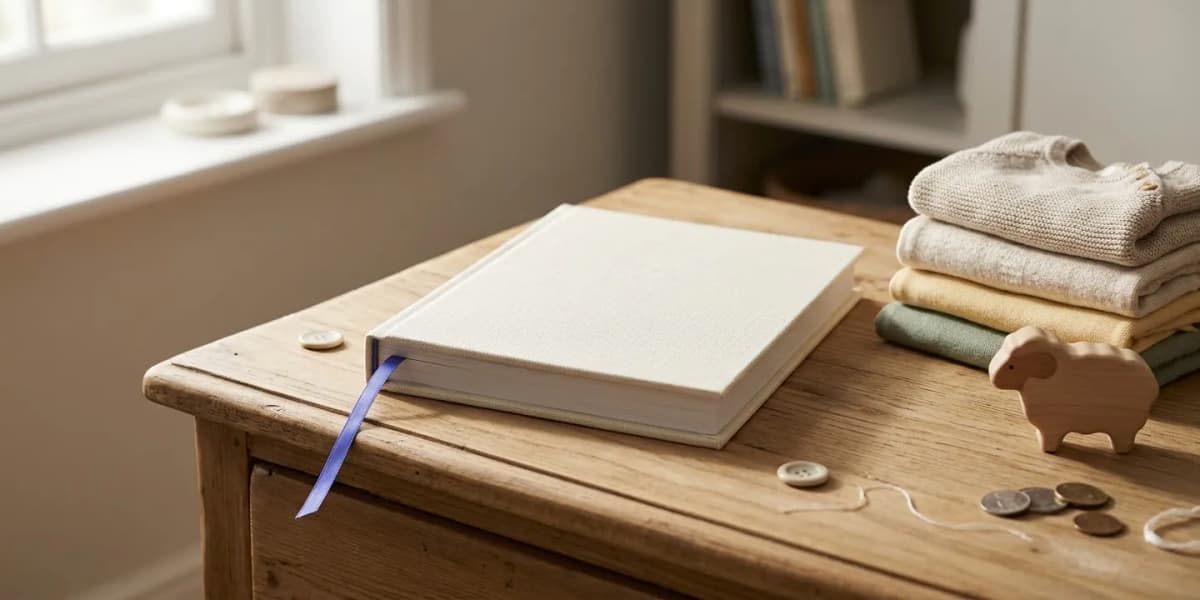
The baby book arrived as a gift. The first pages are full: the name, the weight, the time of birth, maybe a hospital bracelet taped in. Then comes the page for the first smile, and it is still empty.
If that is your shelf, you are in good company. A blank baby book says nothing about how much you love your child. It asks for a ritual in a year with no room for one.
Here is why it happens and what the empty pages cost. Then a lighter way to keep the year, one that asks for a few seconds instead of an evening.
Key Takeaways
- Baby books and nightly journals ask for a sit-down ritual, and the first year leaves no time for one.
- A missed day is not the end. In one habit study, missing a single day did not materially change how the habit formed.
- 75% of the details of an everyday experience are gone within 2 days (Diamond, Armson & Levine, 2020).
- A few words written at the time give you more to come back to than a date and a blank line.
- You don't need to catch everything. Catch a little, skip the rest, and look back once in a while.
The book asks for a ritual
Look at how a baby book is built. It gives you a page per milestone and a line for the date. It assumes you will sit down with a good pen, remember the exact day, and write something worth keeping.
That is a ritual. It needs a quiet half hour, a clear head and the book within reach. In the first year you rarely have all three at once. When the baby finally sleeps, the book is in a drawer and you would rather sleep too.
Nightly journals ask for the same thing in a different shape. They want you at the end of the day, when you are most tired and the day is already a blur. Most people who start one mean it. When it lapses, the problem is the format, not the parent.
There is a second trap in the milestone pages. They ask for the first time something happened, with a date. Often you aren't sure. Was that the first real laugh, or the second? Was it Tuesday or Wednesday? When the page wants a precise answer and you only have a rough one, you leave it blank. You'll fill it in later.
Later rarely comes, and each empty page makes the next one harder to start.
A gap is not a failure
Journals and baby books make a gap visible. A missed week sits there on the page, and it can feel like the whole project has failed.
The research on habits suggests a single missed day matters less than it feels. In one study, 96 volunteers picked a daily eating, drinking or activity behaviour and tied it to a moment in their day, such as "after breakfast". For 12 weeks they reported each day whether they did it and how automatic it felt. Missing one opportunity to do the behaviour did not materially affect how the habit formed (Lally et al., 2010).
That study was about everyday habits like eating, drinking or exercise, not about baby books. It looked at single missed days, not longer gaps. What we take from it is simple: a skipped day is a skipped day, and it does not undo what came before.
The rest is our advice, not the study's finding. If the book has been blank since month two, the kindest move is to stop treating it as a debt. Don't go back and try to reconstruct the missing months from memory. Start again from today.
What the empty pages cost
It is easy to think the big moments are the ones worth writing down. The first steps, the first word, the first birthday. Those are the pages the baby book gives you.
But the first steps get told. You phone a grandparent, you mention it at work, someone takes a video.
The ordinary Tuesday gets told to no one. The way she held your finger during a feed. The song that stopped the crying for a week and then stopped working. The face he made at his first taste of lemon. None of that has a page in the book, and nobody else is keeping it for you.
Research on everyday memory shows how fast that happens. In one study, adults went through a real, one-time experience that could be checked afterwards. Later, they described it from memory. 75% of the details of an everyday experience are gone within 2 days (Diamond, Armson & Levine, 2020). Two days later, people produced less than a quarter of the verifiable details of a half-hour experience.
The same study found something reassuring. The details people did recall were 93 to 95% accurate. Your memory is not broken. What you keep is true. You keep very little of it, and a first year is made of hundreds of ordinary days.
If you want the longer version of why whole weeks run together, why the weeks blur goes into it.
Photos help, but they aren't the whole story
Most new parents do have a record of the year: the camera roll. Thousands of photos, many of them nearly the same.
Photos are worth keeping. But a photo shows what something looked like, not what was going on. It won't tell you why you were laughing. Or that this was the week of the bad cold, or what your partner had just said.
There is also some evidence that the camera changes what you notice. In one study, people on a guided museum tour were asked to look at some objects and photograph others. When they photographed an object as a whole, they later remembered fewer objects, and fewer details about them, than when they only looked. When they zoomed in on a specific part of an object, that effect went away (Henkel, 2014).
A museum tour is not a nursery, and one study is not a verdict on your camera roll. But it is a good reason not to let the photos do all the remembering. A line of words next to a photo gives it back its context.
A lighter way to keep the year
Here is an approach that asks for less than a baby book and gives you more to come back to.
Catch it when it happens, not at night. Write it down the minute it happens, while you are still smiling about it. On your phone, one-handed, during a feed. A few words is enough.
Write what, who and where. What happened, who was there and where you were give you something to hold onto later. "Kitchen, Dad holding her, she laughed at the dog sneezing" will bring more back than "14 March".
Don't aim for milestones. Catch the small, specific things the book has no page for. The milestones already have their pages in the book, and usually a video.
Skip days without guilt. Some weeks you will write down nothing at all. That is fine. There is no page to fill and nothing to catch up on. Start again with the next thing worth keeping.
Keep the baby book as the neat copy. If you love the book, keep it. Fill in the big pages later, from your notes, on a slow afternoon. The notes do the remembering. The book becomes the neat copy.
Look back now and then. It is the reason to do any of it. Once a month, read back what you caught. You will find things you had already forgotten. And you will start to see the shape of the weeks: the stretch when everything was about sleep, the week she discovered her feet.
For more on what is worth catching and what to do on the days you catch nothing, see keeping the first year with a baby.
Where Wonaby fits
Wonaby is one app built for this way of keeping the year. A moment takes a few seconds: a few words, how it felt, an optional photo. When there is enough to say, a recap is waiting in Insights with what happened and the patterns running through it. The free plan includes some weekly recaps; Pro opens every week plus the monthly and yearly recaps. Nothing breaks when you miss a day, and Zen mode hides the streaks.
A notes app, a shared chat with your partner, or a pocket notebook can do much of the same job. What matters is the habit of catching a little and looking back, whatever you use.
FAQ
It's month eight and the book is blank. Is it too late?
No. Start from today and let the missing months go. You can fill in a few big pages later from photos, messages and what people remember, but don't make that a condition for starting.
Should both parents keep notes?
If you both want to, yes. You notice different things, and two short notes about the same afternoon are often better than one long one. Keep it easy: whatever you each already use, and no rules about who writes what.
Related reading
- Why the weeks blur: why whole weeks disappear from memory, and what brings them back
- Keeping the first year with a baby: what is worth catching, and what to do on the days you catch nothing
Sources
- Diamond, N. B., Armson, M. J., & Levine, B. (2020). The truth is out there: Accuracy in recall of verifiable real-world events. Psychological Science, 31(12), 1544-1556. https://doi.org/10.1177/0956797620954812
- Henkel, L. A. (2014). Point-and-shoot memories: The influence of taking photos on memory for a museum tour. Psychological Science, 25(2), 396-402. https://doi.org/10.1177/0956797613504438
- Lally, P., van Jaarsveld, C. H. M., Potts, H. W. W., & Wardle, J. (2010). How are habits formed: Modelling habit formation in the real world. European Journal of Social Psychology, 40(6), 998-1009. https://doi.org/10.1002/ejsp.674
This article was drafted with AI and reviewed by the Wonaby team.