
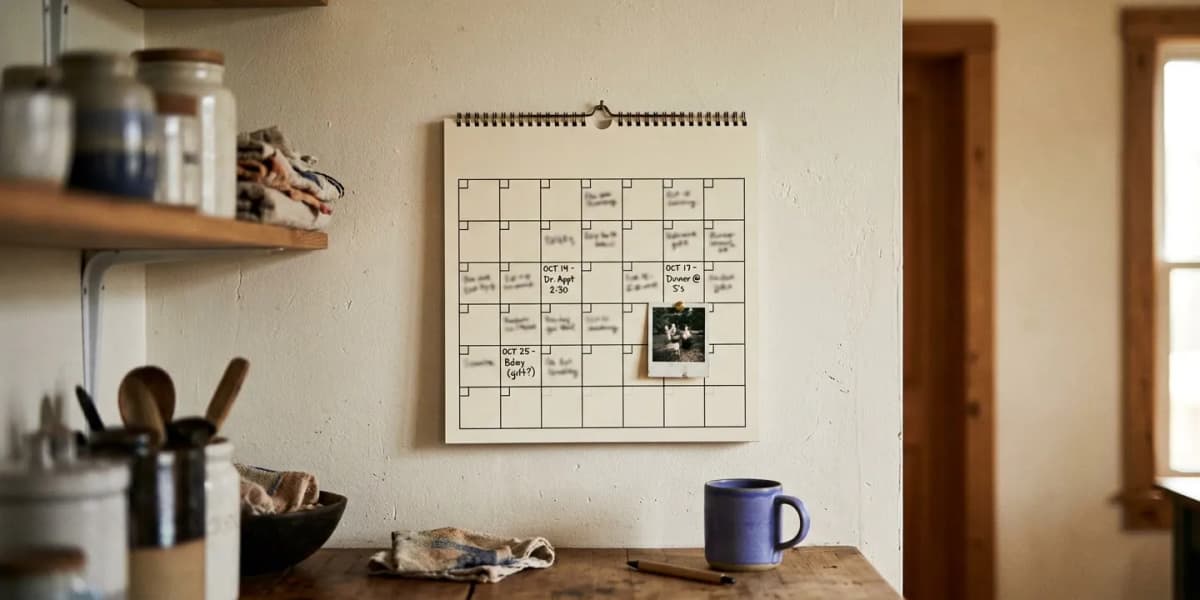
Why the Weeks Blur, and What Brings Them Back
Table of Contents
What did you do last Tuesday? Not the week in general, the Tuesday. For most people the honest answer is a shrug. Work, probably. Dinner, somewhere. A conversation that felt important at the time and has since dissolved.
Then a month goes by like that, and another, and the year feels shorter than it should. If you have ever said "I couldn't tell you what I did last week", you are describing something ordinary memory does to everyone. It helps to know why, because the why also points to what brings those weeks back.
Key Takeaways
- 75% of the details of an everyday experience are gone within 2 days (Diamond, Armson & Levine, 2020), but what people do recall is highly accurate.
- Time spent in routine is remembered as shorter than time spent on something new, which may be one reason similar weeks collapse together.
- People underestimate how interesting their ordinary moments will be to read later, and expect to remember more of them than they do.
- Cues from your own day bring back more of it than someone else's: in one study, people's own camera pictures prompted more remembered events.
How fast the details of an everyday experience fade
In a 2020 study, younger and older adults went through a real, one-time experience that lasted about half an hour. Every detail was on record, so what they said later could be checked. Two days afterwards, people were asked to describe everything they remembered.
75% of the details of an everyday experience are gone within 2 days. People recalled less than a quarter of the verifiable details. That was about a fifth for adults aged 19 to 35, and about a seventh for adults aged 65 to 75 (Diamond, Armson & Levine, 2020).
The second finding matters just as much. What people did recall was 93 to 95% accurate. Your memory is not broken or unreliable. It keeps a small amount, and keeps it well.
That study measured a single half-hour experience, not a whole week, so treat it as a clue rather than a count.
Routine makes time shrink in memory
Losing details is one part of it. The other part is the feeling that the weeks themselves are getting shorter.
William James described it in 1890, long before anyone could measure it. As more of life turns into routine, he wrote, the days and the weeks "smooth themselves out in recollection to contentless units" (James, 1890).
A century later, Dinah Avni-Babad and Ilana Ritov tested the idea. Across four lab experiments, time spent on a routine, repetitive task was later remembered as shorter than the same time spent on a varied one. They found the same pattern outside the lab. Guests at a holiday resort, asked at check-out, remembered the later parts of their stay as passing faster than the first. On a kibbutz, members remembered time on their regular job as passing faster than time on a job outside their usual routine. They rated both jobs as about equally interesting (Avni-Babad & Ritov, 2003).
The authors' explanation is that we judge how long a stretch of time was by the changes we can recall from it. Routine leaves fewer of those marks. A busy week of familiar days can hold a great deal of life and still leave very little behind to measure it by.
That suggests the weeks may blur hardest when life is busy but repetitive. Think of a demanding job, a long stretch of caring for someone, or the first year with a baby, when every day looks like the one before. And a baby's first year can't be repeated. If that is your life right now, we wrote about it on its own in keeping more of the first year with a baby.
Why you don't notice it happening
If ordinary days fade so fast, why doesn't everyone write them down? Part of the answer is that people are confident they will remember.
Researchers at Harvard Business School, led by Ting Zhang, asked people to write down ordinary things from their lives. That meant a recent conversation, songs they had been listening to, an inside joke. Before sealing these "time capsules", people predicted how curious and interested they would be to read them later. When the time came, they were more curious and more interested than they had predicted (Zhang et al., 2014).
The gap was larger for ordinary experiences than for extraordinary ones. The authors link it to people's confidence that they will remember everyday events anyway.
The moments most likely to vanish are also the ones that feel too small to keep. By the time you notice they are gone, there is nothing left to go back to.
What brings a week back
Memory works through cues: a detail, a place, a picture, a few words that reconnect you to the moment around them.
A study at Microsoft Research tested one version of this. A small group of university students wore a camera that took pictures through the day, then later tried to recall what had happened on those days. Looking at pictures of their own day brought back more events they genuinely remembered than looking at another participant's pictures. They could also put their own pictures in the order they were taken, which they could not do with someone else's (Sellen et al., 2007).
The useful part for everyday life is the word "own". A cue works because it connects to something you lived. A stranger's photo of a café is just a café. The study used photos. A few words of your own may work the same way. A note saying "Sam laughed so hard at the café he spilled his coffee" can bring back the whole afternoon.
This is also why a camera roll of thousands of photos often answers so little. It holds the scenes you thought to point a phone at, rarely what the day felt like, and almost never the small thing someone said.
Small ways to keep more of a week
None of this needs a nightly journal or a new routine. The research above suggests a few simple habits, and you can try any of them today.
Catch it the same day. A line written now is worth more than a page written at the weekend. A note on your phone is enough.
Write the small thing. The big days get photographed and retold. The Tuesday is what disappears. A few words about something that made you laugh, annoyed you or surprised you is the kind of record people later find more interesting than they expected.
Add who, where, and how it felt. A name, a place and one word for the mood give your future self something to hold onto. "Rain, late bus, called Mum, felt lighter after" is a whole evening in eight words.
Mark what changed. New places, first times, a different route home. In the routine research, change is what made time feel longer looking back, so it is worth a line when it happens.
Look back once in a while. A record only brings a week back when you read it. Scroll back over the last seven days, even for a minute, and forgotten moments turn up again. So do the threads between them: the friend who kept coming up, the evenings that felt better than you expected.
Let the gaps be gaps. Missing a day, or a week, costs nothing. The habit that lasts is the one that asks for a few words when you have them and nothing when you don't. If you have tried and dropped a journal before, why the baby book stays blank looks at why the nightly ritual is so hard to keep. It is written for new parents.
One way to do this with an app
If you would rather not piece this together in a notes app, Wonaby is built around the same idea. A moment takes a few seconds: a few words, how it felt, an optional photo. When there is enough to say, a recap is waiting in Insights, with the patterns running through it. The free plan includes some weekly recaps; Pro opens every week plus the monthly and yearly recaps. Nothing breaks when you miss a day, and Zen mode hides the streaks.
It is one option. A paper notebook, a notes app or a message to yourself works on the same principle: a few words, close to the moment, read again later.
Related reading
Sources
- Avni-Babad, D., & Ritov, I. (2003). Routine and the perception of time. Journal of Experimental Psychology: General, 132(4), 543-550. https://doi.org/10.1037/0096-3445.132.4.543
- Diamond, N. B., Armson, M. J., & Levine, B. (2020). The truth is out there: Accuracy in recall of verifiable real-world events. Psychological Science, 31(12), 1544-1556. https://doi.org/10.1177/0956797620954812
- James, W. (1890). The principles of psychology (Vol. 1, Chap. 15). Henry Holt. https://psychclassics.yorku.ca/James/Principles/prin15.htm
- Sellen, A. J., Fogg, A., Aitken, M., Hodges, S., Rother, C., & Wood, K. (2007). Do life-logging technologies support memory for the past? An experimental study using SenseCam. Proceedings of the SIGCHI Conference on Human Factors in Computing Systems, 81-90. https://doi.org/10.1145/1240624.1240636
- Zhang, T., Kim, T., Brooks, A. W., Gino, F., & Norton, M. I. (2014). A "present" for the future: The unexpected value of rediscovery. Psychological Science, 25(10), 1851-1860. https://doi.org/10.1177/0956797614542274
This article was drafted with AI and reviewed by the Wonaby team.